

LUMIN helps investigative teams create cases, ingest evidence, enrich artifacts and classify large collections of images and video with speed, structure and control.

LUMIN is designed to adapt to existing investigative workflows, rather than forcing investigators to change the way they work.

Built for investigative teams

Visual evidence review

Expandable by design

From evidence intake to prosecutable clarity.

Investigative teams operate across different countries, changing legislation, fast-evolving online behavior and new technological capabilities. LUMIN responds with a workflow that is flexible, expandable and tailored to specific needs.

Create case

Set up investigations with controlled context, audit trail, review status, and scalable processing

Ingest evidence

Import disk images and folders read-only and extract image, video, sound and document artifacts fast and accurate.

Normalize workload

Deduplicate artifacts using both cryptographic and perceptual hashing algorithms and detect known material using configurable hash set matching. Setup advanced auto-classify rules, markers, and suggestions to further reduce the workload.

Enrich artifacts

Use embedded and third-party AI classifiers to describe the nature of artifacts, use shot-detection to create video summaries and transcribe video and sound to create searchable text.

Classify and analyse

Multi-stage classification allows for a quick assessment of the potential illegality of artifacts and a subsequent analysis of selected illegal artifacts using a configurable and flexible classification schema. The lates version of the Universal Classification Schema is preconfigured. A multi-pane video viewer guarantees the quickest possible review of video.

Report and Share

Reports on illegal artifacts can be created automatically, where the narrative is generated based on the classification schema used and the results of the enrichments.

Purpose-built for visual forensic intelligence

The first production-ready version of LUMIN supports the core workflow of creating cases, ingesting evidence, enriching artifacts, flexible auto-classification rules and multi-pass classification based on the Universal Classification Schema or agency-specific schema’s.

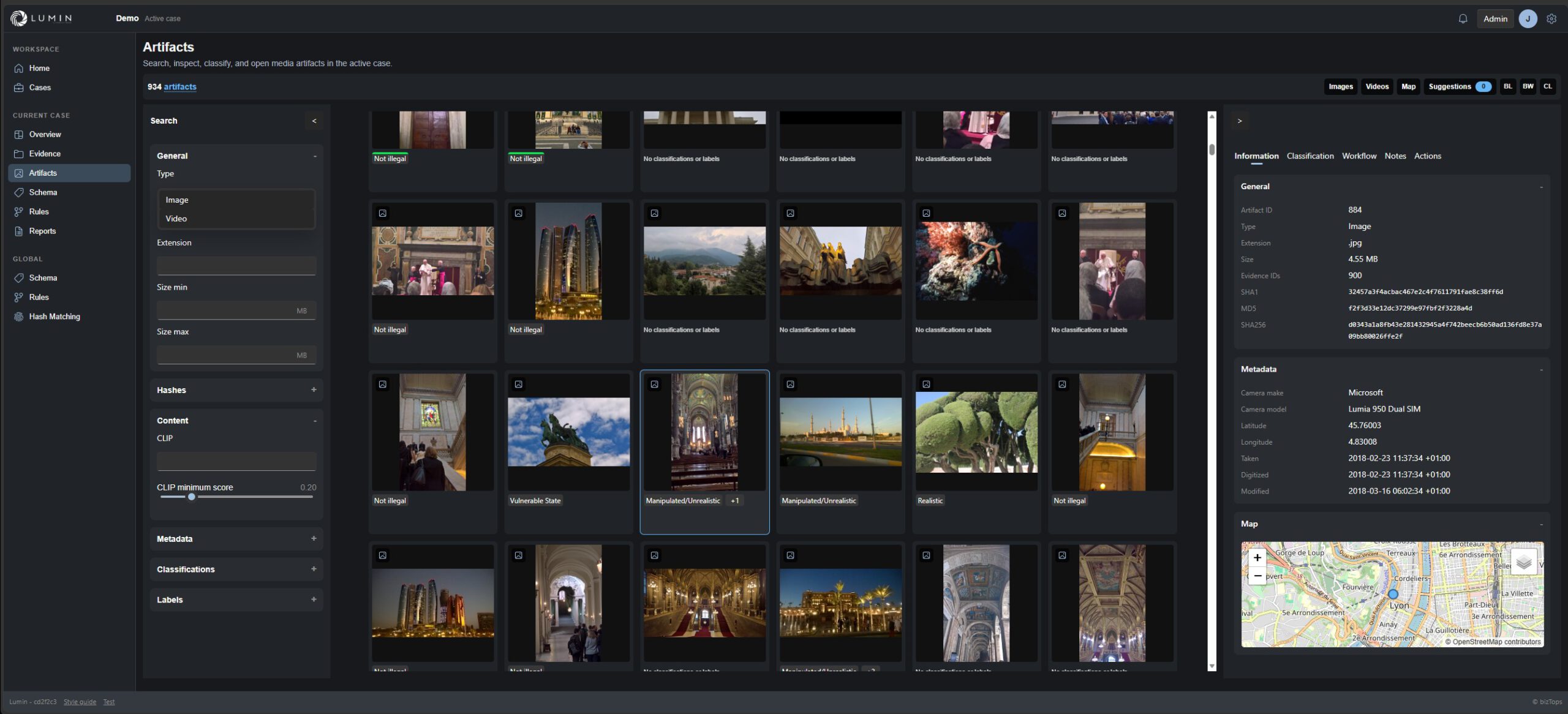
Review large volumes of images and video through faceted search, case counter, status queues, and investigator-friendly review panels.

Use configurable auto-classification and marking rules, and multi-pass review for both rapid assessment and deeper prosecution-focused analysis.

Bring together hash matching, video transcription, facial recognition and AI-assisted indicators into one coherent investigative workspace.

Support integration with peer systems through APIs and existing import/export protocols, without locking agencies into a rigid process.

Designed so investigators remain in control of scope, review decisions and evidential interpretation.

Built to evolve with investigative needs, legislation, reporting channels, and new forms of online visual evidence.

Built to expand with the investigative landscape.

LUMIN is being developed rapidly and can add new functionality quickly as new case types, data sources and agency workflows emerge.

Create cases, ingest evidence, normalize workload, enrich artifacts, classify and analyse and report and share are included in the current version.

Planned ingestion of public reports received from INHOPE Hotlines to connect intake and review workflows.

Planned support for industry reports relayed by NCMEC and Europol, integrating different investigative needs in one coherent system